¶ Overview of identified BMs
The RENergetic project investigated 5 main business models for energy management and investments in energy islands, energy communities, sites, buildings or homes. The process for this identification is described in project deliverable D7.4 - Market analysis and value and business models identification. The business models are:
- Local energy optimization: Local energy optimization, using MuVecO optimizer.
- Energy market optimization: Optimizing flexible assets in the energy market, balancing the grid and generating revenues
- Smart EV charging: Smart charging of electric vehicles, applying demand side management.
- Electricity supply side optimization: Smart design of the electricity supply side and investment, including optimization of battery storage.
- Heat production: Smart design of (waste) heat production and investement, optionally using heat pumps.
The first three business models are based on operational optimization of the applicable assets. The two other models focus more on energy supply via investment in production assets and their design optimization.
All five business models were described based on the learnings by different partners throughout the project. Using an iterative approach, the initial descriptions were reviewed and enriched by the project pilots and researchers in dedicated workshops.
The following section discusses first the general aspects about the business models. After this, the different business models are described more in detail.
¶ Value networks
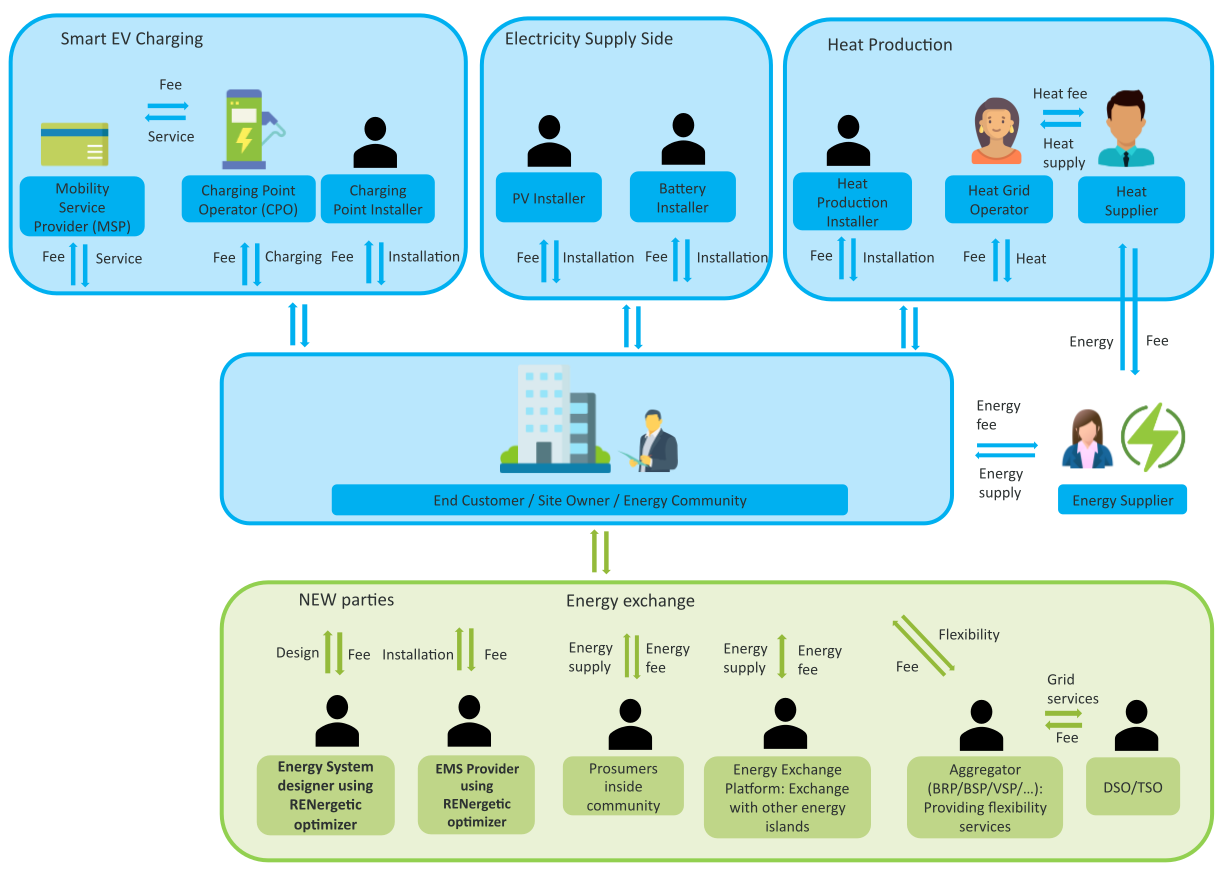
The five business models are situated in overlapping value networks as depicted in Figure 1. As client of the services, the central players in the network are the end consumer, the site owner or the energy community. Some parts of the network are specific for one business model, like the parts concerning smart EV charging, electricity supply side optimization and heat production. In the RENergetic business models, the traditional networks are extended with less conventional parties, shown in green.
¶ Business models
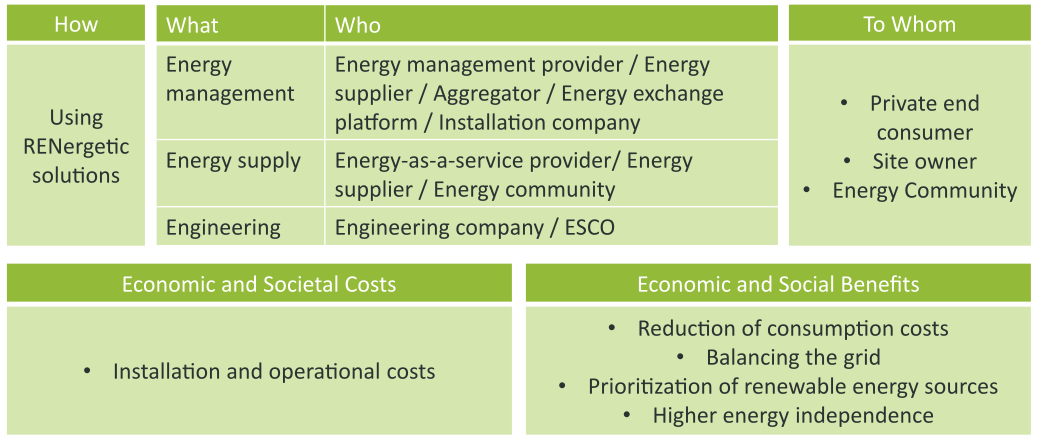
Driven by the project’s objectives, the business models have a lot of aspects in common. Those common element are shown in Figure 2 below. All services are aimed at increasing independence and raising the share of renewable energy. Depending on the cases, the services can also reduce energy costs and improve grid balance.
As described in the overview, three business models are based on operational energy management via smart asset scheduling. The two other business models are related to energy production and the associated engineering.
¶ Business models for energy communities
Energy communities can invest in systems to improve the value for their members. The five systems, described in the overview provide typical systems and services an energy community can benefit from. The community can become a customer of these services and subsequently use them to benefit its members. A community level optimization such as smart steering or energy investments can potentially generate more value than individual optimizations, although legislation plays an important role in the effective value. Community level energy generation has the potential of economies of scale, more possibilities, and better efficiency, depending on the technology. By scheduling assets on community level, impact on the grid can be reduced. This can lead to reduced energy costs, depending on local legislation and tariff systems. Profits in the community can be used to reduce energy costs, to increase the value of a cooperation as organizing entity or can be reinvested in new infrastructure.
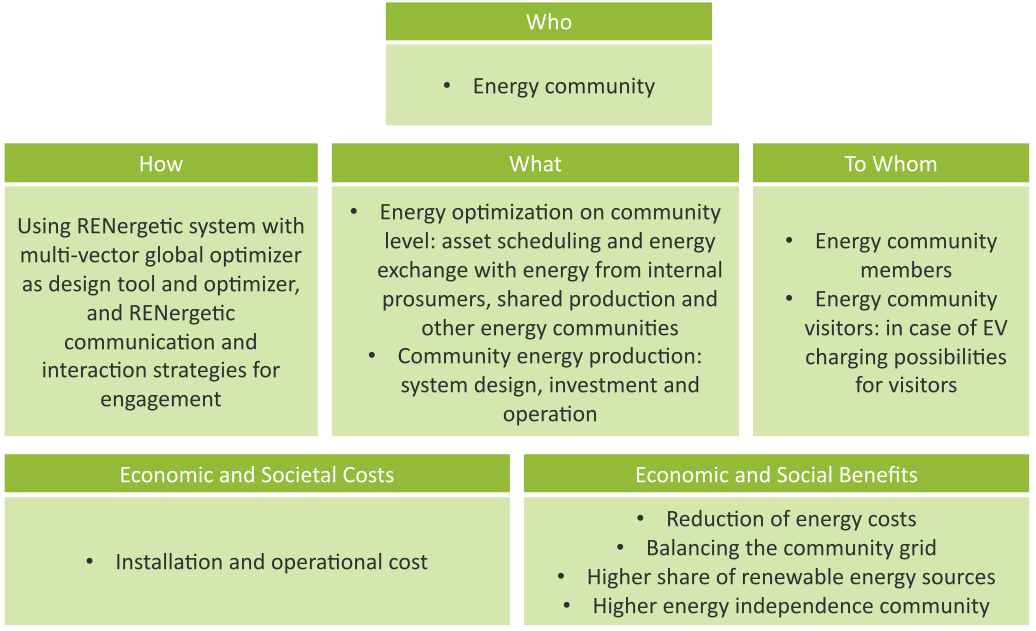
The general business model elements that are common for energy communities are summarized in Figure 3. The community provides its services to its members or to visitors of the site. The costs and benefits are the same as in the general business model, described in Figure 2.
¶ Building blocks
The RENergetic platform’s functionalities and its social toolbox are presented as building blocks that can be utilized together in function of the targeted business model. The five first building blocks in Table 1 are part of the RENergetic platform. The RENergetic communication and interaction strategies are a set of guidelines and insights, presented as a package. Since the RENergetic platform can be used both for operational optimization as for design and feasibility studies, all the discussed business models use some of its functionalities.
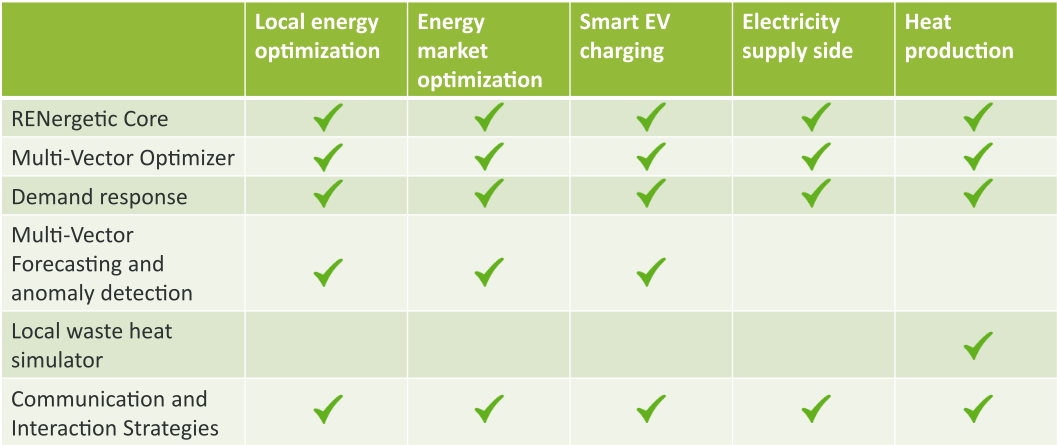
Detailed descriptions of the building blocks created in the project can be found in project deliverable D7.7, section V.1. The building blocks contain the following elements, amongst others
- RENergetic Core: user management, system management, API, GUI, databases.
- Multi-vector optimizer:
- Global Multi-Vector Optimizer: optimize assets as part of complete system in the community/ on the site (as operational optimization and as design tool),
- Electricity Supply Optimizer: optimize energy supply of electrical system in the community/ on the site
- Demand response
- Rule-based demand response: Influence MuVecO so profits can be made from flexibility services
- Scenario-based demand response
- Reinforcement learning-based demand response, e.g. EV demand response
- Multi-vector forecasting and anomaly detection
These services provide essential input for the Multi-Vector Optimizer or automated demand response systems, ensuring accurate and effective energy management. The services include:
- Heat Demand Forecasting: Predicts future heat requirements.
- Heat Supply Forecasting: Estimates available heat supply.
- Electricity Demand Forecasting: Anticipates electrical energy needs.
- Electricity Supply Forecasting: Projects available electrical energy.
- Anomaly Detection: Identifies irregularities in energy patterns to ensure system reliability and efficiency.
- Local waste heat simulator: Simulate waste heat production for feasibility checks or for design purposes
- Communication and interaction strategies
Effective communication and interaction are vital for the successful implementation and acceptance of energy management solutions. Strategies include:
- Public & Private Dashboards: Provide real-time monitoring and reporting to users and stakeholders.
- Virtual Reality Tool: Assists in the initial discussions and setup of energy systems, offering an immersive understanding of the technology.
- Automated Calculation and Visualization of Technical KPIs: Generates insights through the automatic computation and display of key performance indicators.
- Social Toolbox for Energy Awareness and Implementation of technical solutions: Enhances user acceptance and engagement through social initiatives and educational efforts, ensuring the smooth adoption of technical solutions.
¶ Societal and Environmental Impact
The project is aimed at realizing social and environmental impact in energy island. The business models realize this impact by the means of energy management, energy production and energy engineering. The following benefits are common for all the business models:
- Reduced emissions: By optimizing energy systems, we can significantly lower carbon dioxide emissions, contributing to environmental sustainability.
- Enhanced Renewable Energy Use: Prioritizing renewable energy sources helps to further reduce the carbon footprint.
- Community development: Collaborative energy management initiatives can strengthen community ties, fostering a sense of shared purpose and mutual support.
- Empowered citizens: End-users and local communities gain more control over their energy consumption.
- Potential cost savings: Depending on the services and the circumstances, energy costs can decrease for individual users and entire communities.
- Relief of grid strain: The different types of energy management typically have a positive effect on grid strain, by balancing local production and consumption and optionally providing grid services. Investments in energy production help to further reduce consumption from the grid or to provide grid support.
¶ Barriers to the implementation of the business models
The project identified and described the barriers for the RENergetic services and related business models and described them in project deliverable D7.6. These barriers can be mapped with the business models as follows:
Member States Legislation on energy communities for electricity, related to the business models on Energy market optimization, electricity supply optimization and smart EV charging:
- Complex pricing: The current regulatory framework often precludes fair compensation for energy shared within communities, hindering optimal energy management. Reason for this is the mandatory zero energy price for energy sharing from the community to its members. This hinders tailored rewards for optimization efforts by the members.
- Local energy market limitations: Establishing parallel local market structures with separate pricing and trading mechanisms is currently not possible in most MS due to the regulatory framework.
- Demand response for electricity: No regulatory framework for demand response on DSO level in most MS (only pilot projects; might change with the new NC on Demand Response). Congestion management and community self-sufficiency can be potentially in conflict (real-time data and control through DSO is needed)
- Outdated grid fees: Existing fee structures discourage local energy exchange and hinder the development of private distribution grids. Since in the pilot regions, a local exchange causes just as much grid fees as longer distance grid exchange, optimizing for local exchanges does not bring more benefits. The same grid fees make shared electricity production and storage less interesting as well.
- Right to exit communities and switch energy supplier: The right of participants to freely leave energy communities poses risks to the long-term viability of these initiatives. Also the right to freely choose or switch between energy suppliers can pose a risk to the energy community. Although this risk can remain theoretical as long as the community appears the most interesting option for a consumer.
Legislation on grid services, related to the business models on Energy market optimization, electricity supply optimization and smart EV charging:
- Market design limitations: Energy markets are not fully equipped to accommodate the rapid growth of decentralized energy resources and their potential to provide grid services. Current work on consumer centric market design has the potential to improve this situation.
- Minimum power grid services: Current TSO grid services require a minimum amount of power per bid. This makes aggregation necessary for small scale assets.
General technical hurdles, applicable to all 5 business models:
- Interoperability issues: Inconsistent communication standards between devices impede seamless integration.
- Installation complexities: The installation of energy management systems often requires specialized expertise and can be costly.
- Data requirements: Collecting and processing local energy data can be part of qualitative engineering as well as good operational optimizing, but these tasks can be complex and expensive.
Technical hurdles, applicable to EV Demand Response and Energy Market Optimization
- Market infrastructure: The development of robust market platforms for energy exchange is still ongoing.
General social factors, applicable to all 5 business models:
- Capability barriers: Many users do not have the knowledge to fully understand the optimizations in the business models.
- Opportunity barriers: Not all households or businesses have flexible energy assets to optimize or have the possibility to invest in them.
- Motivational barriers: Motivating and organizing community members to participate in energy initiatives can be challenging.